Guide
Take over, convert, or build new: pricing a court facility
The three ways into a court facility, what each adds to the up-front cost beyond the courts, and how to turn a layout into a payback figure you can check.
Published · Updated
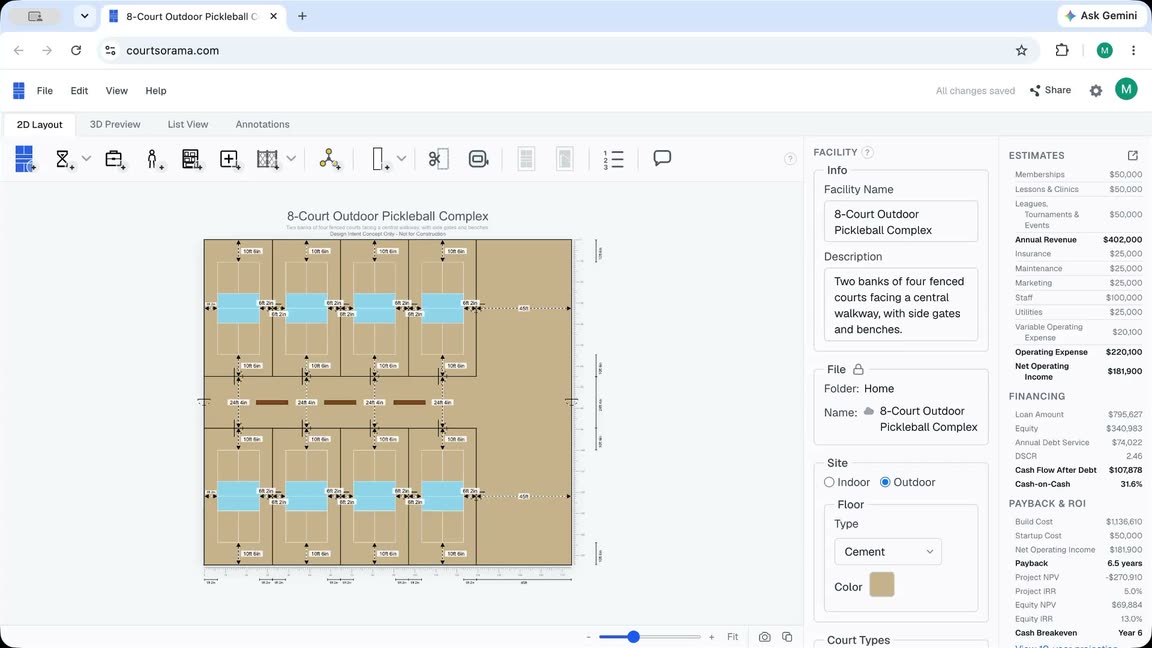
There are three ways into a court facility. You can take over one that is already running, convert an empty building, or build on bare ground. The three paths cost very different amounts, and the difference is rarely the courts themselves. It is everything around them: the purchase or the lease, the building systems, the site work, the soft costs, and the months before the doors open. This guide shows what each path adds to the up-front cost. It then shows how that cost becomes a payback figure, and where Courts-O-Rama fits in.
The up-front cost is more than the courts
Whichever path you take, the up-front cost falls into the same six groups. Price each group, or at least list it, before you compare one property with another:
- The measured work. Courts, fences and gates, walls and dividers, flooring, rooms and seating. This cost grows with the layout, so a drawing can measure it.
- Building systems and site. Demolition and site preparation, electrical service, heating and cooling, fire protection and lighting. These are flat amounts. They do not grow court by court. In a conversion they can be the biggest share of the up-front cost.
- Markups. Design and permits, the contractor’s general conditions, overhead and profit. Add a contingency for what the drawings do not show yet, and interest while the work is financed.
- Equipment and fit-out. Court equipment, furniture, signage, and technology such as audio-visual and point-of-sale systems. Add the sales tax on them.
- Owner costs. The purchase price of the land or the building, legal work and financing fees.
- Opening. Payroll before the first booking, the launch, deposits and a working-capital reserve.
Taking over a running facility
When you buy or lease courts that already exist, a purchase price or a lease replaces construction. The courts, the fences and the floor are there. The up-front cost has three parts:
- the price
- whatever you want to change (resurfacing, new gates, dividers or seating)
- the cost of reopening under your name
Two things decide whether the numbers hold:
- Judge the income as you will run the place. Use your own rates and hours, not the seller’s.
- Decide early whether you buy or lease. A lease takes the largest number out of the up-front cost. It puts that number in the yearly operating budget as rent, and that changes the payback question entirely.
Converting a building
A warehouse, a big-box store, a gym: the building exists and the courts do not. Many indoor pickleball facilities start this way. First-time owners often do not expect where the money goes. It goes into the building itself:
- Heating, cooling and ventilation. A space that was never conditioned for players needs all three.
- Fire protection. A change of use can bring new requirements.
- Electrical service. The courts and their lights need it.
- Demolition. Whatever is there must come out first.
The building also shapes the layout. Its columns and its clear height decide where courts can go.
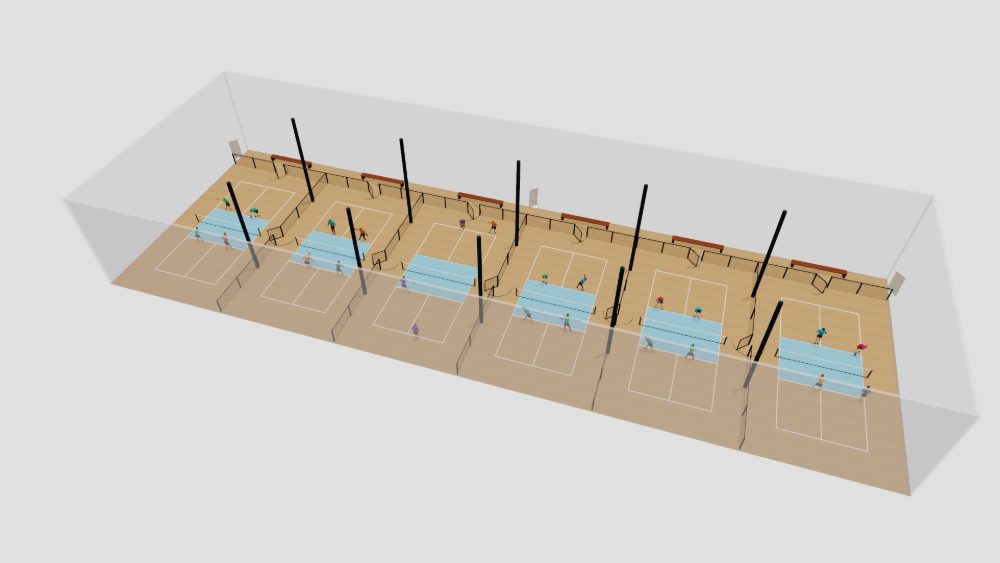
If one floor will host more than one sport, see Multi-sport gym layouts: overlaying basketball, volleyball and pickleball for the layout side.
Building new
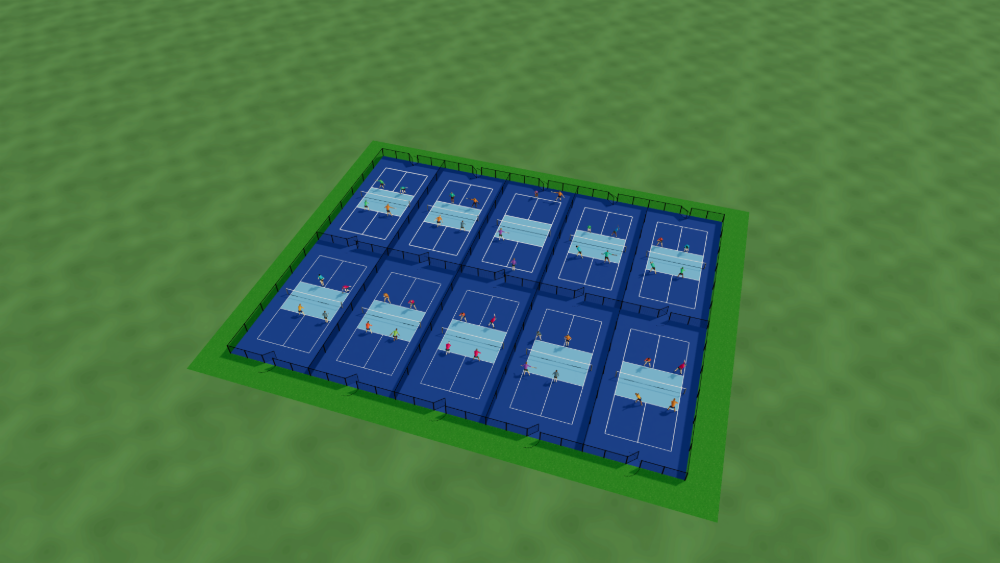
On bare ground everything is new. The up-front cost reads most like a contractor’s bid: site work, the slab, the courts, every fence and gate, the seating, and the land. This path is also where the gaps hide. A court plan does not show:
- parking
- the cost of bringing utilities to the lot line
- the building shell of an indoor build
List those items beside the cost of the courts. Then nobody mistakes the cost of the courts for the whole up-front cost.
From cost to payback
The up-front cost is half the answer. The other half is what the courts earn. Court rental is courts times hours times occupancy times the hourly rate. Figure it separately for prime time and off-peak time.
Other income adds to court rental: memberships, lessons, leagues and events, a pro shop, food and beverage, and sponsorship. The yearly expenses come off it: staff, utilities, maintenance, rent, insurance, property tax and marketing. What remains is net operating income. Payback is the up-front cost divided by net operating income. The result is a number of years.
Here is an example in round placeholder figures:
- Up-front cost: $1,500,000. A construction total of $1,400,000 plus $100,000 of pre-opening cost.
- Net operating income: $300,000 a year. Revenue of $900,000 minus expenses of $600,000.
- Payback: 5 years. That is $1,500,000 divided by $300,000.
The result moves quickly with the income. If net operating income is $200,000 a year, the same facility pays back in 7.5 years.
Watch for two traps:
- A shared floor. A floor that two sports share hosts one game at a time. Split its hours between the sports. Do not count the hours once for each sport.
- The opening years. A new facility rarely opens at the occupancy it reaches a couple of years in. Give the first years their own, lower numbers.
How Courts-O-Rama helps
Courts-O-Rama is a facility planner built for this early stage, when you are still deciding what to build and whether it pays back:
- The quantities come from the drawing. Lay out the courts, fences, walls, rooms and seating. Or trace them over a site plan that you calibrate to scale. The construction estimate then counts and measures them for you: courts by sport, fence footage by height, floor and room areas, doors, gates and seating.
- The rates are yours. The planner ships no price list. You enter every rate, lump sum and percentage for your market. A zero rate says “this exists and I am keeping it”. A blank rate says “not priced yet”. That is how one construction estimate handles a takeover, a conversion and a new build. The purchase price, the building systems, the markups and the soft costs each have their own lines.
- An optional AI assistant. It can fill in rates from a sentence like “price the pickleball courts at 30,000 each and add a 10 percent contingency”. It runs on your own Anthropic API key. You add the key in Settings, and Anthropic bills you for the use.
- Cost and payback side by side. The operating budget turns court-hour rates, memberships and expenses into net operating income and payback. It also gives loan and equity figures, a multi-year projection with an opening ramp, and an occupancy sensitivity table. It splits the hours of a floor that two sports share. Move a court and every number updates.
- Ready to share. The construction estimate and the operating budget export to PDF and CSV. Go over them with your contractor and your accountant before you rely on either.
A few starter templates come with a complete example construction estimate and operating budget, in round placeholder figures. You can see one priced before you enter your own rates. Inside the app, the help explains every line of the construction estimate. It also sets the estimate up step by step for a takeover, a conversion and a new build.
Have it reviewed before you rely on it
Do not rely on the construction estimate or the operating budget unless a qualified professional has discussed it with you and reviewed it. Do not show either one to a lender, an investor or a partner before that review. A contractor reviews the rates and quantities. An accountant or financial adviser reviews the assumptions and the returns.
Both are planning tools built from numbers that you entered. Courts-O-Rama supplies no prices and no market data, and it verifies none of what you enter. The construction estimate is not a bid, and the operating budget is not financial advice. That is why the cost page carries the notice “Planning estimate, not a contractor's bid” and the operating budget carries “Not financial or investment advice”. An export of the operating budget asks you to acknowledge that notice first.
Next steps
Courts-O-Rama is in beta and free to try. To see where a planner like this sits next to AutoCAD, Revit and SketchUp, read How to lay out a court facility: CAD vs. purpose-built tools.
Frequently asked questions
- Is it cheaper to take over, convert or build new?
- It depends on the property more than on the path. A takeover is mostly the purchase price or the lease, plus what you change. A conversion is mostly the building systems and the fit-out. A new build is mostly the site work, the courts and fences, and the land. Courts-O-Rama supplies no prices, so a comparison is only as good as the rates you enter for your market. Draw each option and price it the same way. That makes the three comparable.
- Does Courts-O-Rama supply construction prices?
- No. Courts-O-Rama builds the construction estimate, but the prices in it are yours. It ships no price list. You enter every rate, lump sum and percentage, as a whole number in the facility's currency. A few starter templates come with a complete example construction estimate and operating budget in round placeholder figures. You can see one priced before you enter your own rates. Whatever rates you use, have a contractor review the construction estimate before you rely on it.
- Can the estimate include buying the land or the building?
- Yes. The purchase price goes in the Land & Building Acquisition line under Owner Soft Costs. It is added to the total without markups or sales tax, so it reaches the payback figure and the loan sizing. It is never saved into your defaults, so one property's price never lands in the next facility's construction estimate. If you lease instead, the rent goes in the operating budget.
- How is payback computed?
- Payback is the up-front cost divided by net operating income. The up-front cost is the construction total plus any one-time startup or pre-opening cost. Net operating income is the annual revenue minus the annual operating expense. Payback shows a dash when there is no up-front cost at all, or when net operating income is zero or negative. Every figure is pre-income-tax and comes from your own assumptions. Have an accountant or financial adviser review the operating budget before you rely on it.
- What if two sports share one floor?
- Courts of different sports whose play areas overlap by more than 15 percent of the smaller one are treated as one shared space. A shared space hosts one sport at a time. A wall, fence or hanging divider separates two courts only when it runs between their lines, all the way across the overlap. A curtain across the middle of a basketball court does not separate it from the courts on each half. The operating budget splits the hours of a shared space between its sports, evenly unless you set the split. The operating budget always shows a note that asks you to verify the mix.