Guide
Converting a tennis court to pickleball: dual-use lines or a full conversion
Dual-use lines or a full conversion, how many pickleball courts a tennis pad really holds, what changes on the ground, and how to draw it first.
Published · Updated
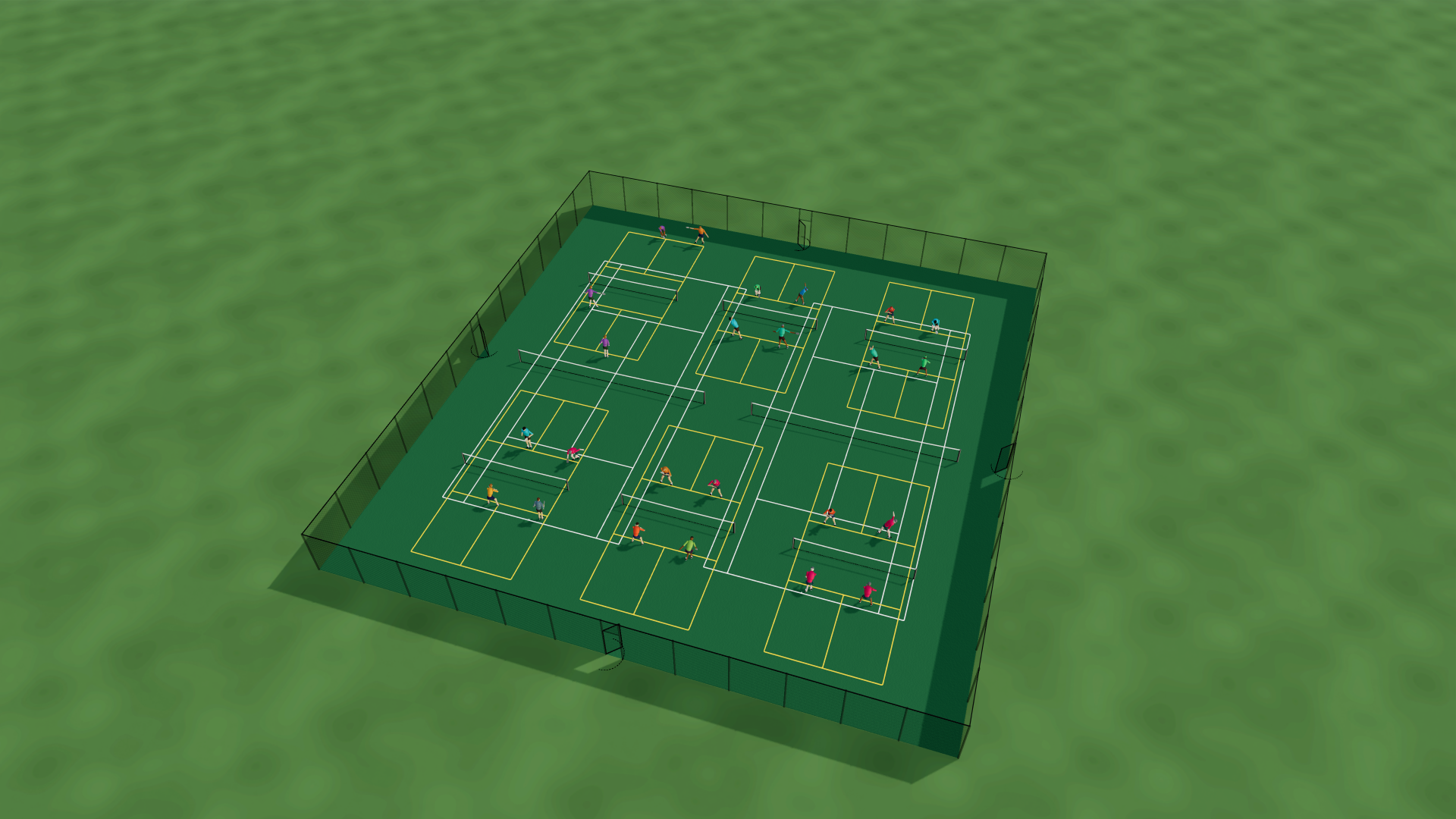
Most towns have more tennis courts than tennis players. They also have more pickleball players than pickleball courts. A tennis court is already a flat, fenced, drained pad in a place people know. That makes it the cheapest pickleball site there is, so the question comes up at every parks board and club meeting. This guide covers the two ways to convert a court, dual-use lines or a full conversion. It shows how many pickleball courts a tennis pad really holds, what changes on the ground, and how to draw the options in Courts-O-Rama before anyone buys paint.
Two footprints, one pad
A doubles tennis court is 36ft (11m) by 78ft (23.8m) inside the lines (ITF). The lines are the small part of the site. The court sits on a pad that gives players room behind the baselines and beside the sidelines. The pad is what you convert.
Tennis guidance puts the pad at 60ft (18.3m) by 120ft (36.6m) for a recommended court. The minimum is 56ft (17.1m) by 114ft (34.7m). Park courts built decades ago land anywhere between the two. Measure your pad fence to fence before you count courts.
A pickleball court is 20ft (6.1m) by 44ft (13.4m) inside the lines (USA Pickleball). It has a 7ft (2.1m) non-volley zone on each side of the net. The court also needs room around it. USA Pickleball asks for a playing area of at least 30ft (9.1m) by 60ft (18.3m) per court. That is 5ft (1.5m) beside each sideline and 8ft (2.4m) behind each baseline. The preferred playing area is 34ft (10.4m) by 64ft (19.5m).
Those two playing areas decide how many courts fit. The 20ft (6.1m) by 44ft (13.4m) court does not.
Dual-use lines or a full conversion
The first decision is whether tennis survives. Everything else follows from it.
Dual-use: pickleball lines painted over a live tennis court
The tennis court stays as it is, with its lines, net posts and net. Pickleball lines are painted over it in a second color. The pickleball nets are portable. They come out when tennis is booked.
Early conversions sometimes used the tennis net for one pickleball court centered on it. The center strap was pulled down to pickleball height. This is no longer a suitable option. Pickleball players now expect a court that meets the official standard. A net that someone must lower for every pickleball session and raise for every tennis match causes friction between the two groups.
Dual-use lines are the cheap option and the reversible one. A repaint at the next resurfacing puts the court back. The option also has costs that each group of players feels in small ways:
- Two sets of lines on one surface. They are harder to read than one. The pickleball color must contrast with both the tennis white and the court color.
- No permanent barriers. A fence or a net post in the middle of a live tennis court ends tennis. So nothing stands between the pickleball courts, and balls roll from one pickleball game into the next.
- Courts that straddle two pads. Where two tennis courts share a slab, a pickleball court that sits partly on each pad is usually ruled out. It is blocked whenever either tennis court is in play, and it blocks both when it is. A site that wants tennis and pickleball side by side keeps every pickleball court inside one tennis court. On tennis pads narrower than the recommended width, that costs a column of pickleball courts. Give the two sports separate time slots and the slab is the only limit.
- One sport at a time. On any one court, a given hour is tennis or pickleball, not both. Some sites run a booking schedule. Many public courts stay first come, first served. Either way, a dual-use pad has to answer who gets the court at peak hours. Tennis and pickleball can still run side by side on separate courts in the same bank.
Because it costs so little and undoes so easily, parks departments often start here. They paint pickleball lines on one or two tennis courts and watch how heavily they are used. They also watch how often the two groups collide over a court. That measures demand before anyone commits to a full conversion or to new dedicated courts. The lines are a survey as much as a facility.
Full conversion: the tennis court is gone
The tennis net posts come out and their sleeves are filled. The surface is recoated in the pickleball layout with no tennis lines left. Permanent pickleball nets go in on their own posts. Fences or netting can go between the courts and along the ends, because there is no longer a tennis court to cut across. The result plays like a purpose-built pickleball site and holds as many courts as the slab allows.
The costs are the resurfacing, the new posts and fencing, and the loss of the tennis court. On a public site that loss is a decision for the parks board and its tennis players, not just the pickleball club.
| Dual-use lines | Full conversion | |
|---|---|---|
| Tennis | Still playable, one sport at a time | Gone |
| Lines | Two colors on one surface | Pickleball only |
| Nets | Portable pickleball nets | Permanent, on their own posts |
| Barriers between courts | None across the tennis court | Fences or netting where you want them |
| Courts per slab | As many as fit inside each tennis court, so both sports can play side by side | As many as fit on the slab |
| Cost | Paint and portable nets | Resurfacing, posts, fencing |
| Reversible | Yes, at the next repaint | Only by converting back |
The middle path: convert some courts, keep the rest
Many parks with a bank of several courts take a middle path. They fully convert some courts and keep the rest for tennis. Every court then carries one set of lines and one net. Nobody shares a court, and each group gets its own space in the same park.
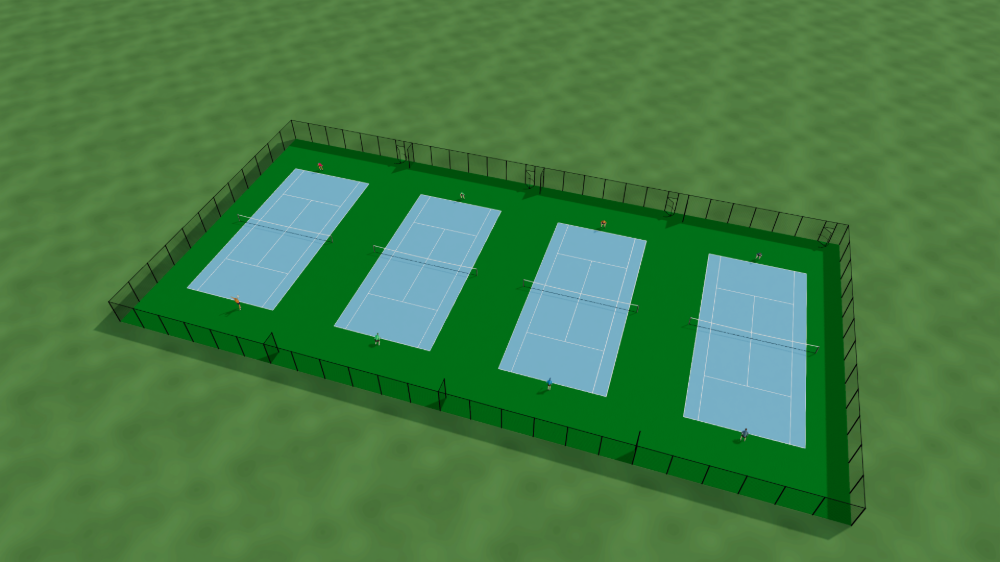
The example below is a bank of four tennis courts inside one fence, modeled on Argyle Forest Park in Jacksonville, Florida. Each court sits on a recommended 60ft (18.3m) by 120ft (36.6m) pad. The four pads share one slab, 240ft (73.2m) end to end.
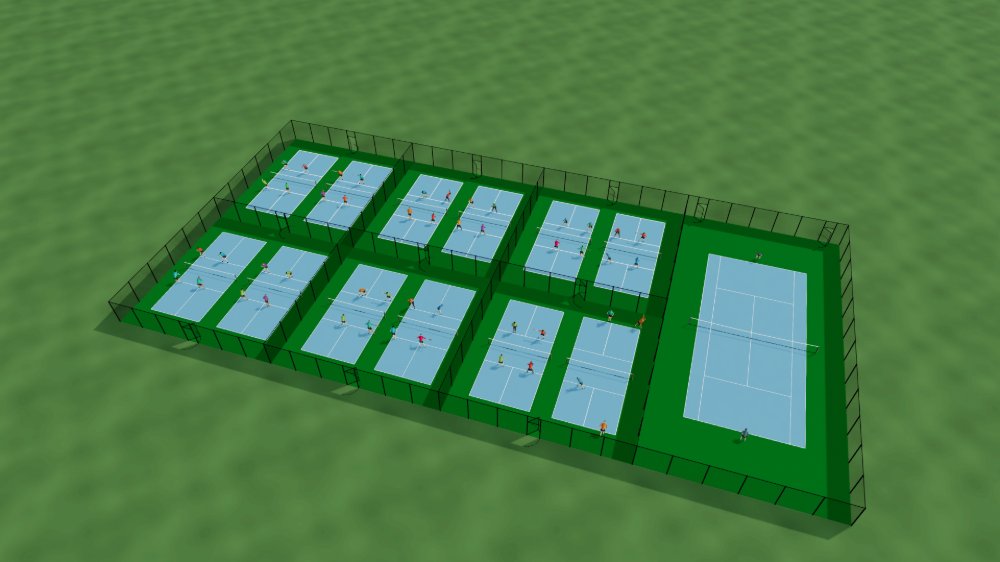
In the converted layout, three of the four pads are converted and one stays a tennis court. Each converted pad takes the standard layout known as the four-on-one, because it puts four pickleball courts on one tennis court. That is four dedicated pickleball courts, two across and two deep. The tennis lines are gone and the tennis net posts are out.
A fence runs along each old net line. A player who backs up for a lob stops at the fence instead of running onto the court behind. The three openings between neighboring pads are closed. Each pad becomes its own enclosure, and a stray ball stays on its own pad.
The bank goes from four tennis courts to twelve pickleball courts and one tennis court on the same slab. The outer fence stays where it always was. The new fence comes to 510ft (155.4m): 180ft (54.9m) along the old net lines and 330ft (100.6m) across the openings.
How many pickleball courts fit
The count depends on the pad. Tennis pads come in a few common sizes. The figures below count whole pickleball playing areas at USA Pickleball’s minimum of 30ft (9.1m) by 60ft (18.3m). The pickleball courts run the same way as the tennis court, two rows deep.
One tennis court
- A standard recreational tennis court sits on a pad 60ft (18.3m) wide by 120ft (36.6m) long. Such a pad holds four pickleball courts at the minimum playing area, two across and two deep. This is the layout usually called the four-on-one: four pickleball courts on one tennis court.
- Some cities built narrower tennis courts. A pad 56ft (17.1m) wide but still 120ft (36.6m) long holds only two pickleball courts, one behind the other. A second column would need 60ft (18.3m) of width.
- Rarely, a city built tennis courts that are both narrower and shorter. A pad at the 56ft (17.1m) by 114ft (34.7m) minimum holds only one standard-size pickleball court.
Two tennis courts side by side
- Two standard tennis courts side by side occupy a square slab 120ft (36.6m) on each side. Such a slab holds eight dedicated pickleball courts, four across and two deep.
- Some cities squeezed the two tennis courts together. A slab 110ft (33.5m) wide, for example, holds only six dedicated pickleball courts, three across and two deep. The middle column straddles the two tennis pads.
Three tennis courts side by side
- Three standard tennis courts side by side occupy a slab 180ft (54.9m) by 120ft (36.6m). Such a slab holds twelve pickleball courts, six across and two deep.
- Some cities squeezed the three tennis courts together. A slab 155ft (47.2m) wide, for example, holds only ten dedicated pickleball courts, five across and two deep.
One caveat on the straddling courts in the counts above. Tennis courts laid out side by side are sometimes built on separate slabs, with expansion joints between them. A pickleball court laid across such a joint has the joint running through its playing surface. Whether that is acceptable depends on the joint and on how the slabs have moved. Ask a court builder or a pavement engineer to look at the joints before you count on a straddling court.
What changes on the ground
- Line color. On a dual-use court, players must tell the pickleball lines from the tennis white lines at a glance. The lines must also stay readable where a fence shadow falls across them. Dark blue or black lines vanish in shade; white and bright yellow do not. The sun and shadow guide covers where those shadows fall. Pick one color for all the pickleball lines on a pad. A line that changes color partway along is the most common complaint from players on converted courts.
- Nets. A tennis net stands 36in at the center. A pickleball net is 34in at the center and 36in at the posts (USA Pickleball). That two-inch difference is why lowering the tennis net for pickleball has fallen out of favor. It never quite matches the standard along the whole width, and someone has to reset it for every change of sport. Plan on pickleball nets of their own: portable on a dual-use pad, permanent after a conversion.
- Fences and gates. With four pickleball courts on one tennis court, the tennis fence already stands behind the pickleball baselines. That is good. It does not separate the four courts from each other. A full conversion is the chance to add that.
- Neighbors. Four pickleball games make more noise, more often, than one tennis match. The complaints come from the houses nearest the pad. A conversion near homes is a planning conversation as much as a paint job. Bring a site plan that shows where the courts sit relative to the property line.
- Timing. Acrylic court surfaces are recoated every few years. If you paint pickleball lines the year before a scheduled recoat, you pay for them twice. If you paint them with the recoat, you can reconsider the whole layout at once.
Doing it in Courts-O-Rama
Courts-O-Rama is a concept-stage planner for court facilities. The tennis-to-pickleball question is one it was built around. The workflow is:
- Draw the pad at its real size. Or drop in a photo or scan of the site plan and calibrate it to scale with two known points.
- Add the tennis court.
- Turn on the facility setting Courts can overlap (different sports).
- Place pickleball courts on top of the tennis court. With the setting on, new pickleball courts arrive with a transparent surface and pavement-yellow lines, so they read as markings on the tennis surface. Each court keeps a Lines color picker for the color the site actually uses.
To model a full conversion instead, check Hide Net on the tennis court and paint its lines in the surface color. The planner then treats it as a blank pad. Its spacing annotations disappear, fences can cross it, and seating can stand on it.
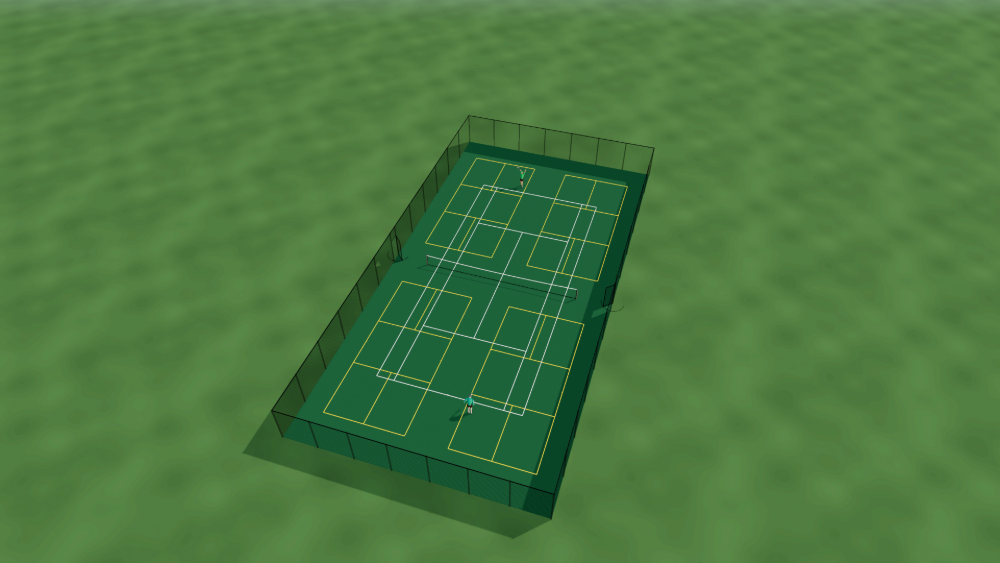
Once the courts are down, three layout checks do the checking:
- Line overlap. The View > Line Overlap overlay highlights every place a pickleball line lies along a tennis line. A check called Court lines overlap or nearly overlap lists them. It flags pairs of parallel lines from different sports whose centers sit less than 4in apart. It looks at straight parallel lines only. Lines that cross at right angles are fine and are not reported, and arcs are not modeled. On a dual-use pad it usually finds a pickleball sideline on a tennis doubles sideline. The fix is to shift the pickleball court by a foot or two.
- Run-off behind the baselines. A check called Insufficient space behind baseline flags a pickleball court with less than 7ft 6in (2.3m) clear behind a baseline. That threshold is a little under the 8ft (2.4m) minimum on purpose, because converted tennis courts so often land just short of it. The message still quotes the recommended depths, so you know where the layout stands.
- Barriers between courts. A check called Baseline must be protected by a barrier flags two pickleball courts that face each other baseline to baseline with nothing between them. On a dual-use pad that comes down to where the tennis net is and where it is not.
- Where the tennis net counts. The two rows of pickleball courts meet on the tennis net line. The check counts the net as a barrier only along its span, 42ft (12.8m) post to post.
- Where it runs out. Any pickleball court that reaches past the ends of a net is flagged. So is a court that straddles two tennis courts, because there is no net where their pads meet. With four pickleball courts on one tennis court, both columns reach past the net’s ends. With six on two, the middle column has no net under it.
- What players do about it. In practice, pickleball players are likely to fill those gaps with improvised barriers. Netting or a row of ball carts strung between the tennis nets is meant to keep a long ball off the facing court. The planner cannot know about those, so it keeps the warning.
- What the check offers. It will not offer to draw a fence across a tennis court whose lines show, because that would end tennis. If the tennis net is hidden, it offers to show it instead. The conversion starter templates keep these warnings on purpose. They are a real trade-off of pickleball courts over a live tennis court, not a drawing error.
Like every layout check in the planner, these are a curated set of common mistakes, not a compliance review. An empty issues list means none of the checks fired. It does not mean the pad is right. The in-app help has the detail on what each check looks at.
Beyond the checks, two more things change once courts overlap:
- Stacking order. The Bring forward and Send backward buttons decide which court is drawn on top. In the 3D preview, only the top court of a stack is populated with players.
- Operating budget. The budget treats courts of different sports whose playing areas overlap by more than 15 percent of the smaller one as one shared space. A shared space hosts one sport at a time. The budget asks you for the split of hours between tennis and pickleball instead of counting five courts running at once.
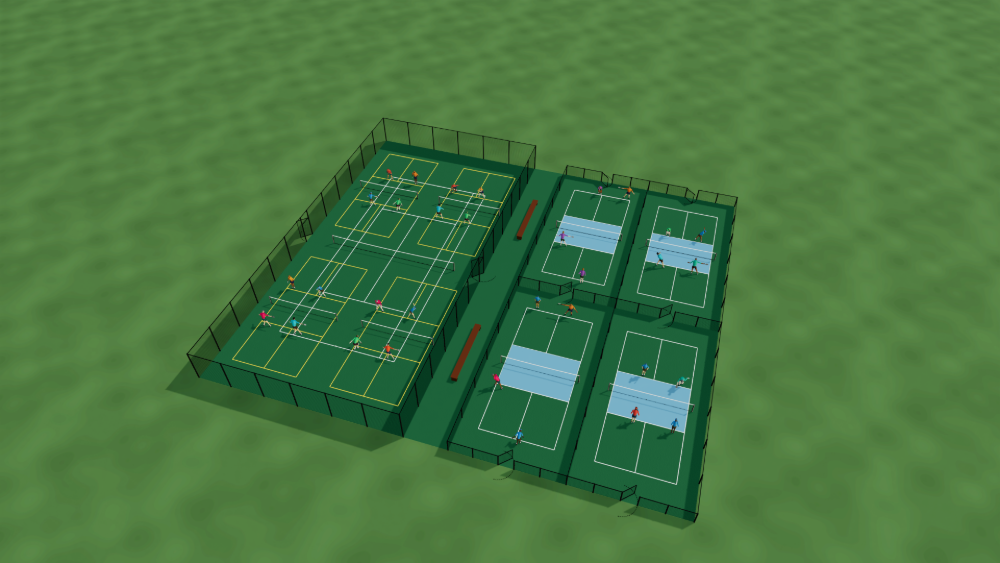
Four of the starter templates are tennis conversions. Start from the one closest to your site:
- Tennis-to-Pickleball Conversion: four pickleball courts on one tennis court, shown above.
- Park Conversion with Pickleball Lines: two park courts, each with two pickleball courts, so either sport can take a pad.
- Six Pickleball Courts over Two Tennis: six courts over a two-court slab, with the middle column straddling the two nets.
- Dedicated and Overlaid Court Mix: a variation on the middle path, dedicated pickleball courts beside a tennis court that carries blended lines.
Two case studies walk through real converted courts: Shoreview Park, Shoreline, WA: fixing the pickleball lines on two converted tennis courts and Peter Kirk Park, Kirkland, WA: six pickleball courts short behind the baseline, and eight that are not.
When the layout is settled, export a dimensioned PDF for the board. Export a DXF for the contractor’s or architect’s CAD tools and an SVG for the graphics team. Every drawing is stamped “Design Intent Concept Only - Not for Construction”, because that is what a concept plan is.
The optional AI assistant can lay out four pickleball courts on a tennis court for you from a typed or spoken description. It runs on your own Anthropic API key, added in Settings and billed to you by Anthropic.
Next steps
Courts-O-Rama is in beta and free to try. For the indoor version of the same overlay question, see Multi-sport gym layouts: overlaying basketball, volleyball and pickleball. For what a conversion puts in the budget, see Take over, convert, or build new: pricing a court facility.
Frequently asked questions
- How many pickleball courts fit on one tennis court?
- It depends on the pad, not the tennis lines. A pickleball court needs a playing area of at least 30ft (9.1m) by 60ft (18.3m). A tennis pad at the recommended 60ft (18.3m) by 120ft (36.6m) holds four, two across and two deep, each at the minimum. A smaller tennis pad holds fewer than four. Two tennis courts on one slab hold six to eight.
- What is the difference between dual-use lines and a full conversion?
- Dual-use keeps the tennis court playable. Pickleball lines are painted over it in a second color, and the pickleball nets are portable. It is cheap and reversible. But each court hosts one sport at a time, the two sets of lines compete, and nothing permanent can stand between the pickleball courts. A full conversion removes the tennis net posts and recoats the surface with pickleball lines only. It adds permanent nets and any fencing between courts, and it gives up tennis on that pad.
- Can pickleball use the tennis net?
- It used to be done for one pickleball court centered on the tennis net. The center strap was pulled down from the tennis height of 36in to the pickleball height of 34in. This is no longer a suitable option. Pickleball players expect a court that meets the official standard, and a net that someone must adjust at every change of sport causes friction between the two groups. Two or four courts on one tennis court sit on either side of the tennis net anyway. They need their own nets: portable on a dual-use pad, permanent after a conversion.
- Can I draw pickleball courts on top of a tennis court in Courts-O-Rama?
- Yes: turn on the facility setting "Courts can overlap (different sports)", then place pickleball courts over the tennis court. New ones arrive with a transparent surface and yellow lines, so they read as markings on the tennis surface. Each court has its own Lines color picker. To model a full conversion instead, hide the tennis court's net and paint its lines in its surface color. The planner then treats it as a blank pad. Two tennis courts, or two pickleball courts, still cannot overlap.
- Why does the planner flag the outer courts when four pickleball courts are laid on one tennis court?
- Because the tennis net does not reach them. A tennis net spans 42ft (12.8m) post to post, but the two rows of two pickleball courts on one tennis court span 60ft (18.3m). The outer courts face each other baseline to baseline past the ends of the net, with nothing between them. The check called Baseline must be protected by a barrier says so. The planner will not offer to draw a fence across a tennis court whose lines still show, because that would end tennis. On a dual-use pad the warning is a real trade-off of the layout, not something to fix.
- With multi-use courts, how close can different sports' lines be before the planner flags them as being too close?
- The court-line-overlap check flags two parallel lines from different sports whose centers sit less than 4 inches apart. That catches a pickleball sideline painted on a tennis doubles sideline. It compares straight parallel lines only. Lines that cross at right angles are not reported, and arcs are not modeled. Treat it as a check on the common mistake, not a full review of the markings.