Case Study
Shoreview Park, Shoreline, WA: fixing the pickleball lines on two converted tennis courts
Six pickleball courts painted over two tennis courts, and two line problems players feel daily. A 2ft shift and a color change fix both without repaving.
Published
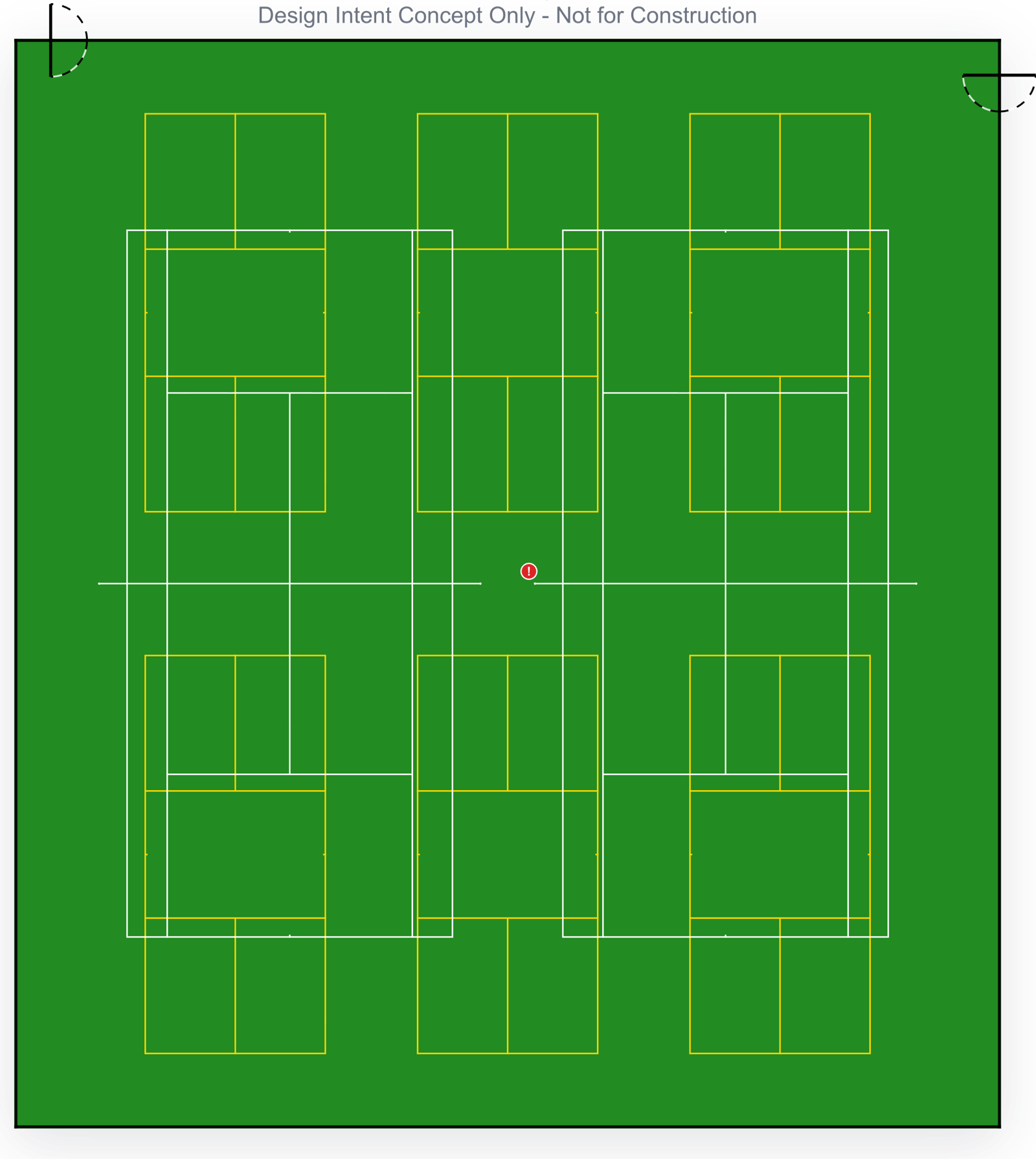
These courts were designed for tennis first and pickleball second. In practice they are used mostly for pickleball, and the pickleball players pay for the order of priorities every time they play: lines that change color partway along, and lines that vanish against the tennis paint or into the shadow of the fence. This study redraws the courts as they are, lets the planner’s checks name the two problems, and then fixes both with a 2ft (0.6m) shift and a can of yellow paint. Nothing is repaved.
The courts today
Shoreview Park in Shoreline, Washington, just north of Seattle, has a row of public tennis courts. The two southernmost were converted for dual tennis and pickleball use around 2020: the tennis lines stayed, and six pickleball courts were painted over them, three across and two deep. The drawing below reflects the courts as they are in 2026.
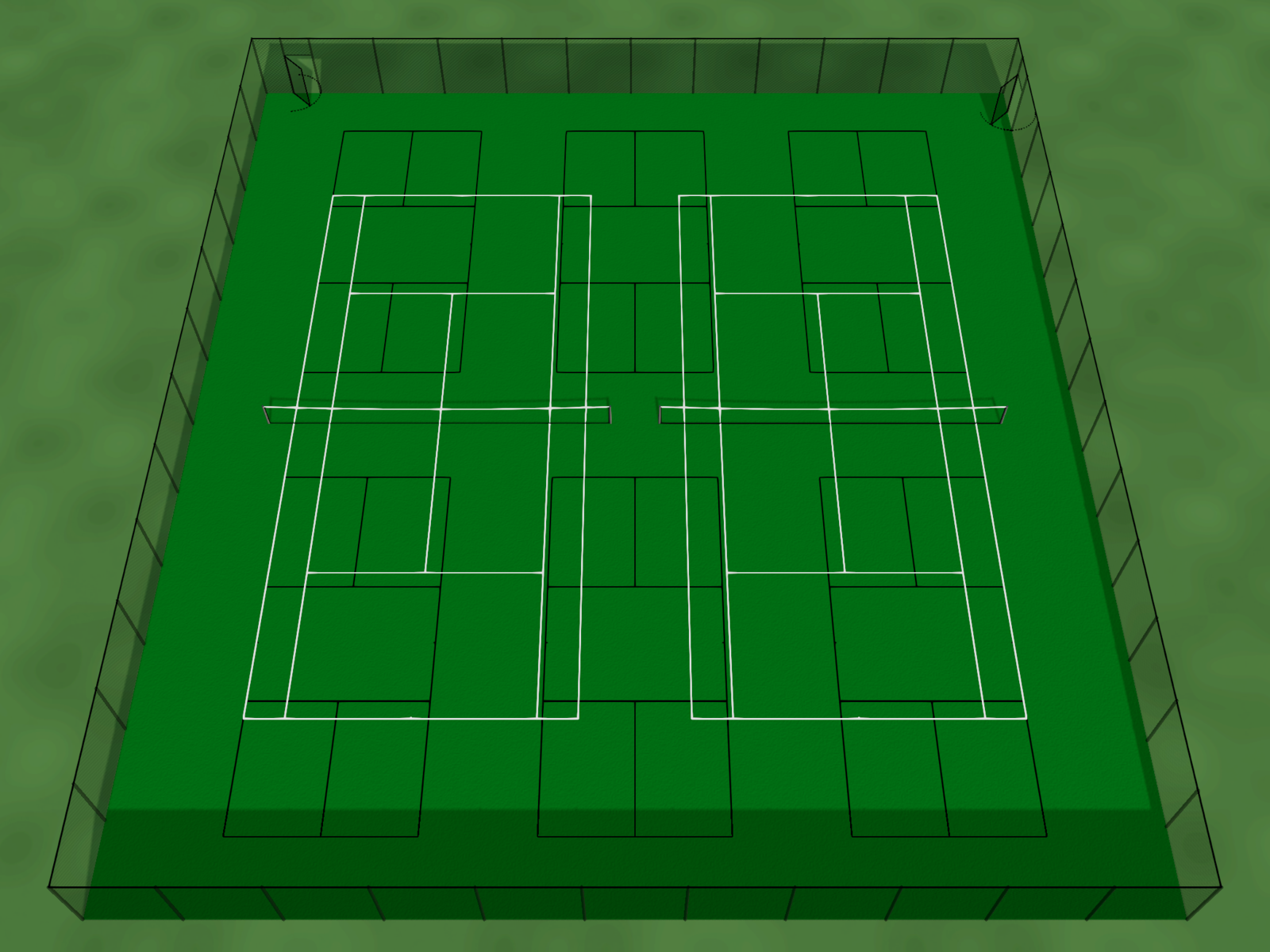
The pad is one fenced rectangle, roughly 108ft 8in (33.1m) by 120ft (36.6m) (estimated from satellite imagery, not surveyed), with a 10ft (3m) chain-link fence on all four sides. The two tennis courts sit side by side in white; the six pickleball courts are painted in black, with the middle column straddling the gap between the two tennis courts and the two outer columns sitting inside them.
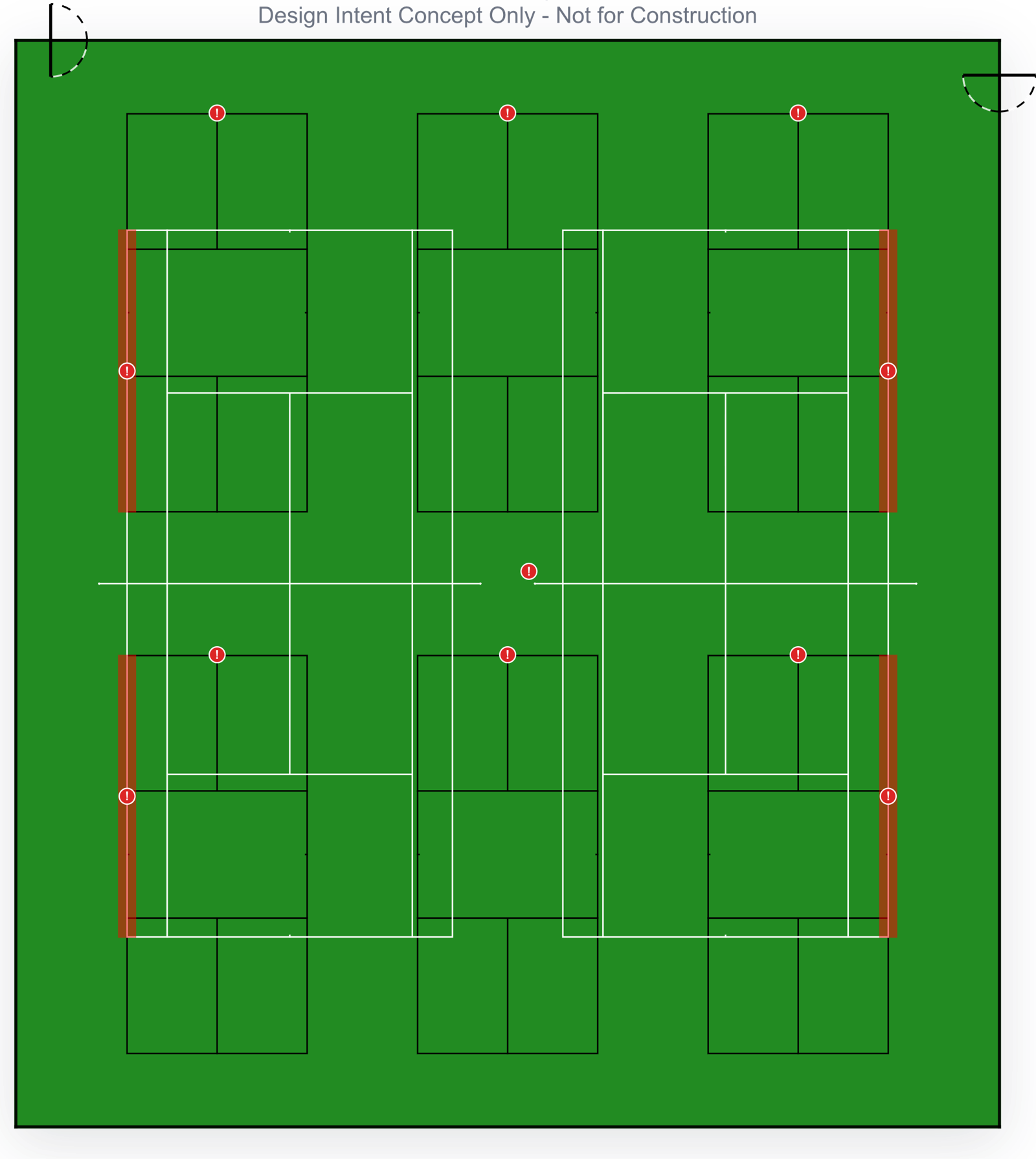
Drawn in Courts-O-Rama with the “Courts can overlap (different sports)” setting on, so the pickleball courts read as markings on the tennis surface. The Line Overlap view highlights every place where a pickleball line runs along a tennis line, and the Layout Issues list reports what the checks find. On this layout they find four Court lines overlap issues, six Fence shadow obscures court lines issues, and one Baseline must be protected by a barrier issue. The first two are the problems the players describe. The third is discussed at the end.
Problem 1: pickleball lines change color partway through
In this design, the tennis lines are always white. The pickleball lines are black, except where they overlap a tennis line and turn white. On the four outer pickleball courts, the tennis doubles sideline overlaps the pickleball outside sideline. These four pickleball sidelines end up being black for about a quarter of the way and continue in white for the last three quarters. A single line starts in one color and ends in the other.
Courts-O-Rama’s Court Lines Overlap layout check catches exactly this. It compares parallel straight lines from courts of different sports and flags pairs that sit on or nearly on top of each other; it deliberately ignores lines that cross at right angles, since crossing is unavoidable when two sports share a surface. The multi-sport gym guide describes the check and its limits in more detail.
Problem 2: white lines dominate and black lines disappear
White tennis lines reflect sunlight and grab the eye, which is obvious even in satellite images. The black pickleball lines fade into the surface:
- Next to a white line, the black line is easy to miss. On the four outer pickleball courts the kitchen line is black end to end, but the white tennis baseline runs about 2ft behind it, and the pickleball players often stand behind the bright tennis baseline, mistaking it for their kitchen line.
- In fence shadow, which covers part of the courts for part of the year, black lines become almost invisible. From the kitchen line you may not be able to see your opponent’s baseline at all.
Courts-O-Rama models the second point. With the facility’s location set, the Fence shadow obscures court lines check sweeps three representative dates and projects the perimeter fence’s shadow onto each court’s boundary lines. On the current layout it flags every pickleball court and lists when the shadow crosses. For the top-left court on June 21 it lists two windows: 6:00 AM–7:15 AM (top perimeter fence across the top boundary line), the whole of an early summer morning session with the baseline in shadow, and 5:15 PM–7:15 PM (left perimeter fence across the left boundary line), two hours of the evening with the outside sideline in shadow. For the bottom-left court on March 20 it is 8:00 AM–5:30 PM (bottom perimeter fence across the bottom boundary line): the baseline nearest that fence sits in shade from morning to evening. The sun and shadow guide explains what the check looks at and what it leaves out.
The fix: move the outer courts, repaint the lines
Two changes, both paint.
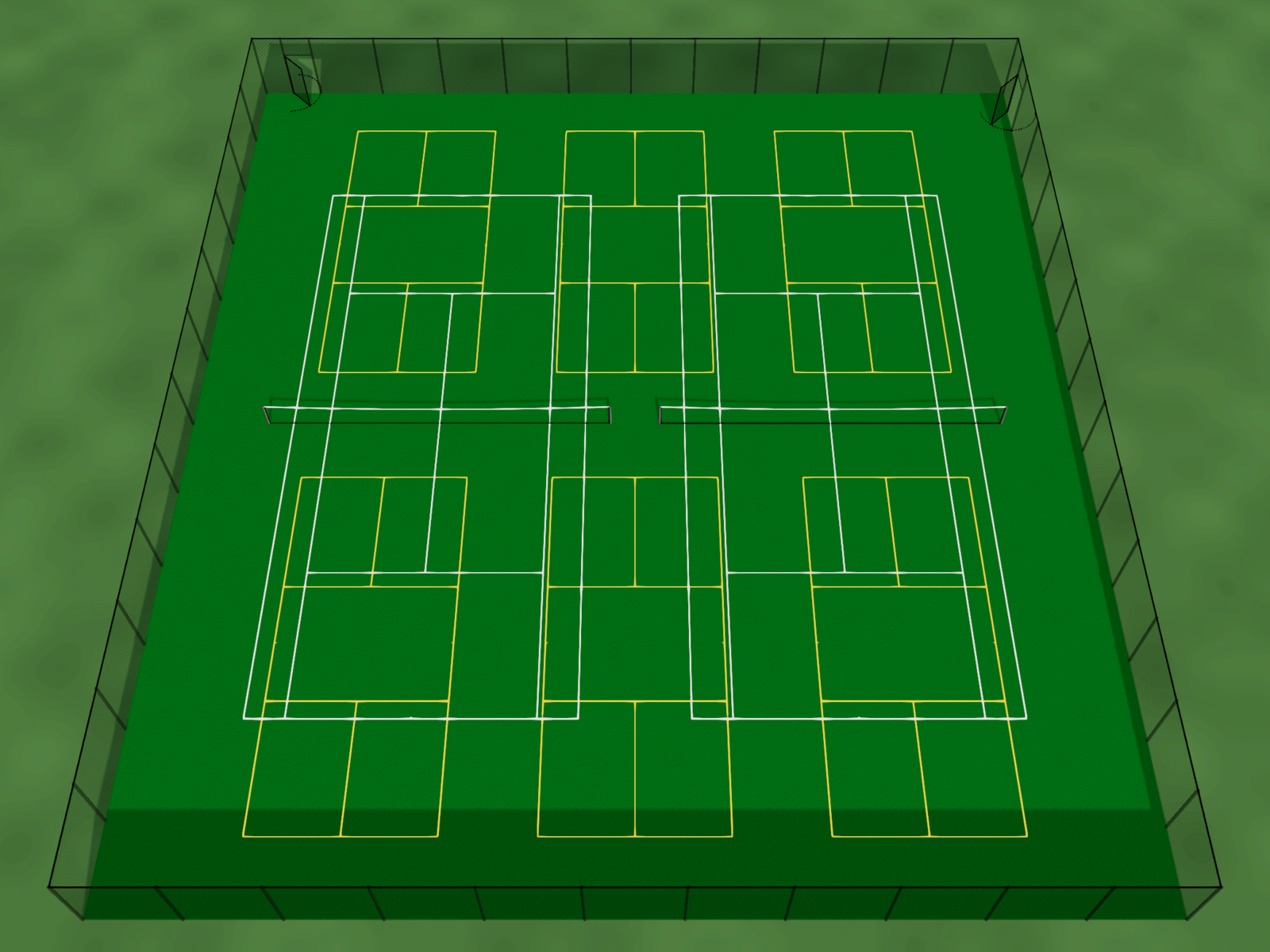
- Shift the four outer pickleball courts 2ft (0.6m) toward the center. Their outside sidelines land inside the tennis doubles sidelines instead of on top of them. The two sets of lines still cross, but every pickleball line is now a single color from end to end, and the check goes from four issues to zero.
- Repaint the pickleball lines in high-visibility yellow. Yellow stands out against the white tennis lines and the green surface, and it stays readable when the fence shadow crosses it; the shadow check treats white and high-visibility yellow lines as readable in shade, so it goes from six issues to zero. Lowering or moving the fence would also reduce the shadow, but at far greater cost than paint.
In the planner the second change takes two clicks in each court’s shadow-issue popover: Fix it for me…, then Paint lines high-visibility yellow. Or select all six pickleball courts and set their Lines color once in the Properties panel. The first change is a 2ft (0.6m) nudge of four courts with the arrow keys or the Properties panel, and the Line Overlap highlights disappear as each court moves.
Before and after
| Current (2026) | Improved | |
|---|---|---|
| Outer pickleball courts | Outside sideline on the tennis doubles sideline | Moved 2ft (0.6m) toward the center |
| Pickleball line color | Black | High-visibility yellow |
| Court lines overlap | 4 issues | 0 |
| Fence shadow obscures court lines | 6 issues | 0 |
| Baseline must be protected by a barrier | 1 issue | 1 issue |
| Surface work | None; both changes are paint | |
One issue stays. The two middle pickleball courts meet baseline to baseline across the tennis net, so a player backing off one middle court can step onto the other without being stopped by the tennis net. Pickleball balls are also likely to roll from one middle court to the other through that same space. Expect pickleball players to jerry-rig a temporary ball barrier in the space between the two tennis nets.
Open the layouts yourself
Both layouts are ordinary Courts-O-Rama files. Download them, sign in (Courts-O-Rama is in beta and free to try), and open them with File > Import Courtsorama File. The Annotations tab holds the notes this study is based on, the Layout Issues list shows the checks above, the Line Overlap view highlights the shared lines, and the 3D preview’s Sun & Shadow Study shows the fence shadow on any date and time. The PDF export prints the annotations as a preamble page ahead of the plan.
- Current layout (2026): The courts as they are painted today: black pickleball lines, outer courts on the tennis sidelines.
- Improved layout: The proposal: the four outer pickleball courts moved 2ft toward the center, all pickleball lines repainted yellow.
The layout checks are a curated set of common mistakes, not a compliance review, and an empty issues list is not a clean bill of health. The observations about where players stand are the author’s own, from playing on these courts.
Frequently asked questions
- How far do the outer pickleball courts move in the improved layout?
- Each of the four outer courts moves 2ft (0.6m) toward the center of the pad, so its outside sideline lands inside the tennis doubles sideline instead of on top of it. The pickleball and tennis lines still cross, which is unavoidable on a shared surface, but no pickleball line runs under a tennis line for more than a few inches anymore, and Courts-O-Rama's court-line-overlap check goes from four issues to none.
- Why repaint the pickleball lines yellow rather than white?
- Yellow contrasts with the white tennis lines and with the green surface, and it stays readable when the fence shadow crosses it. Courts-O-Rama's fence-shadow check treats white and high-visibility yellow lines as readable in shade, so repainting clears the six shadow issues it reports on the current layout. Lowering or moving the fence would also help, but it costs far more than paint.
- Does the improved layout clear every check?
- No. One issue stays: the two middle pickleball courts meet baseline to baseline across the tennis net, so a player backing off one court can step onto the other. Courts-O-Rama's checks are a curated set of common mistakes, not a compliance review.
- Can I open these layouts myself?
- Yes. Both layouts are linked at the end of the study as .courtsorama files. Courts-O-Rama is free to try while it is in beta: sign in, open a file, and the Annotations tab holds the notes this study is based on, the Layout Issues list shows the checks, and the 3D preview's Sun & Shadow Study shows the fence shadow on any date and time.